- ai
Chatbot vs AI agent: how to tell them apart before you buy
Many chatbots are sold today as AI agents. Here are 4 concrete questions to tell them apart before paying for something that is not what you were promised.
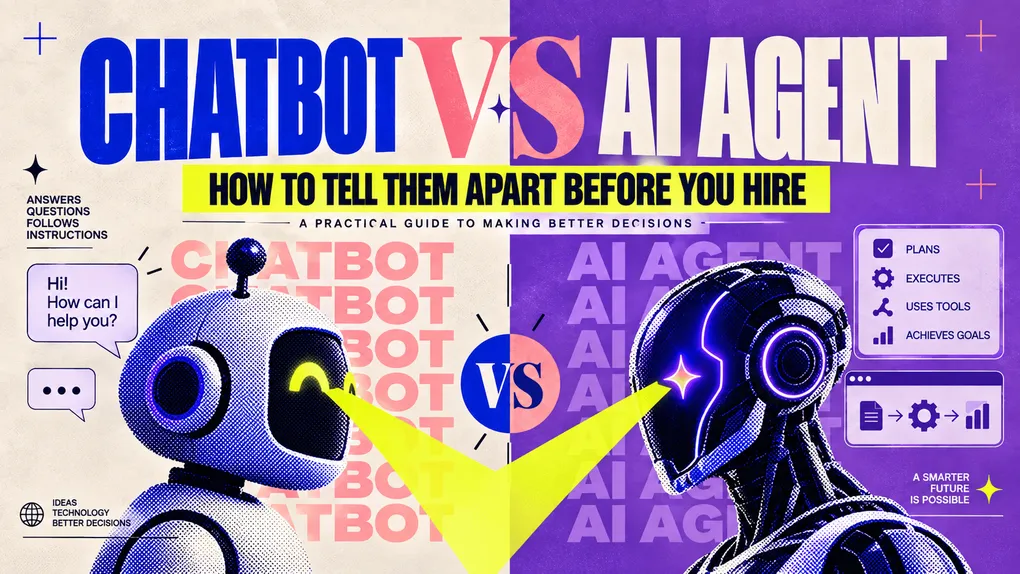
Today almost anything is sold as an AI agent, including plenty of old-school chatbots with a fresh coat of marketing on top. The distinction is not a technicality: if you sign up for something expecting it to handle complex conversations and act on your systems, and it turns out to be a chatbot running fixed scripts, you will end up disappointed with the same problem unsolved. This helps you tell one from the other before paying for something that is not what you were promised.
What a chatbot really is
It runs on fixed rules. It recognizes keywords or buttons, follows a script put together in advance, and when the conversation strays off that script, it stalls, repeats the same answer, or hands off to a human. It is a useful tool for simple, well-bounded FAQs, but it neither reasons nor decides: it executes the path someone programmed.
What an AI agent really is
It understands the intent behind what it is asked, not just the words. It can handle a conversation that did not follow the expected script, and most importantly: it can connect to your real systems (your point of sale, your customer database, your inventory) and act on them, not just talk. That connection to real systems is usually done through an MCP server, which is precisely what gives the agent something to work with beyond a conversation.
4 questions to tell them apart before you buy
- What happens if you ask it something unplanned? A chatbot stalls or repeats itself. An agent reasons and answers, even when the question is new.
- Can it carry out a real action in your systems, or only chat? If it only answers questions and cannot, say, place an order or check your real stock, it is a chatbot with a tidier interface.
- Can they show you a live demo with one of your questions, not one from the sales script? A chatbot staged with test cases falls apart there. A real agent solves it on the spot.
- Does it improve with use, or always answer exactly the same way? An agent adjusts its behavior with the context of each conversation; a chatbot repeats the same thing whenever the question matches its script.
What this looks like in practice
We build AI agents that meet this bar: connected to real systems, able to resolve a conversation end to end with no fixed script. One of our projects serves a restaurant’s customers over WhatsApp, answering questions, taking orders, and managing reservations by acting directly on the business’s systems, not just chatting. You can also see how that connection to real systems is technically built in our article on MCP servers.
Frequently asked questions
Is a chatbot always worse than an agent? No, for simple FAQs a chatbot is enough and costs less. The problem is paying agent prices for something that is a chatbot.
How do I know whether what I have today is a chatbot or an agent? Try asking it something off the obvious path: if it stalls or repeats itself, it is a chatbot.
Is migrating from a chatbot to an agent a big project? It depends on how many systems need connecting, but there is no need to start from scratch: the existing conversation can stay while the ability to act on your systems is added.
Closing
If you are not sure what you have today, or what you are about to be sold, tell us what you need to solve and we will tell you what you are actually working with, as part of our custom AI solutions projects.